Yard Map
A route is a sequence of permissions, not a decoration problem.
Puejo maps small public places by the moments where visitors make decisions. Instead of starting with a sign schedule, the yard starts with the approach, threshold, split, holding point, and recovery path. This makes weak cues easier to diagnose: the entrance may be visible but not welcoming, the counter may be obvious but not named, or the exit may be technically marked but hidden by the route people actually take.
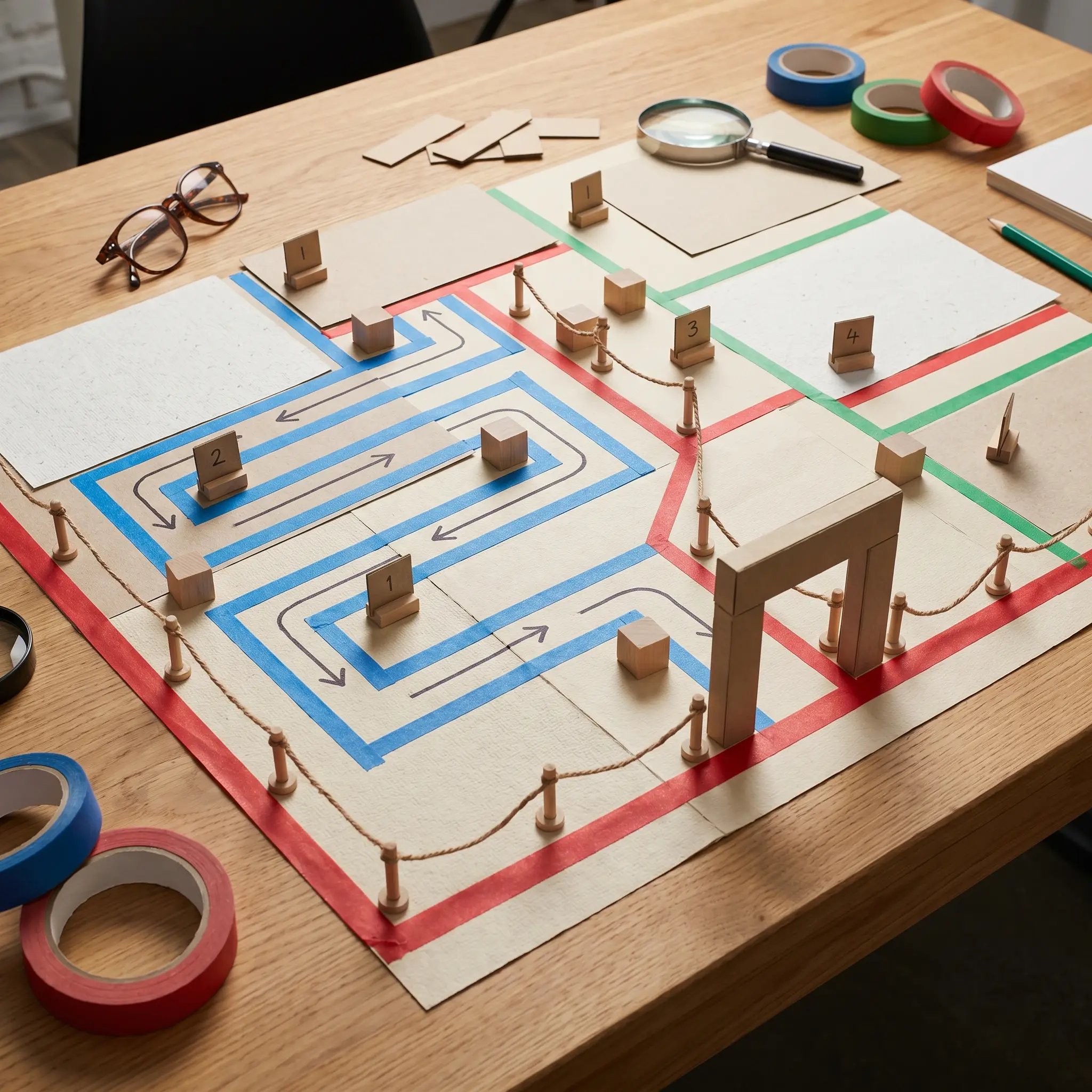
1
Approach
What can the visitor understand before crossing the threshold?
2
Threshold
Which door, desk, counter, or path looks legitimately public?
3
Split
Where do two possible routes compete for attention?
4
Hold
Where does a visitor pause, queue, wait, or search for permission?
5
Recover
How does someone correct a wrong turn without starting over?
How to use the map
Walk the route with a first-time visitor in mind. Record every point where a person needs to infer a rule: whether a door is open to them, whether a path is staff-only, whether a queue begins at the front or side, whether a color marks a destination or just a brand surface, and whether the next cue appears before the previous cue loses authority. The map becomes a maintenance tool when those moments are reviewed after furniture moves, seasons change, events crowd the entrance, or a printed notice stays up longer than planned.